California Dreamin

I’m working up my narrative of the “Myth of California.” For this young boy in New England in the 1960s, it was hot rods, music,  a magic land, a lighthouse in the distance …

I’d love to hear your image!

—–
File:T-Bucket.jpg

T-Bucket Hot Rod.   See end of this post for attribution

California Dreamin

in New York and San Francisco
rooms filled with smoke
as the beat poets worked their magic
with alcohol fueled inspiration

while in my corner of the world
there was snow in winter
or softball games in the church parking lot
as the light softened on a summer evening

and always the woods
hilly           laced with decaying stone walls
glades of sunshine
pockets of cool cool dark
and in our damp cellar in December
“If every body had an ocean”
floating in from the AM radio.

cars were the way out
my closet filled with Hot Rod Magazine
way before I could drive
pages full of dripping chrome
metalflake paint

         sunny

                    top down

                              California cars

two long low dragsters
poised at the starting line for Winternationals
mountains in the background
at a place called Pomona
men in shirtsleeves and sun sun sun

around the corner
on a brilliant July day
on the old road past our front yard
comes a bright red Triumph sports car

          gleaming

neighbor’s older brother driving

          shirtless

                    dark dark tan

                              back from California

“We’ll all be plannin’ out a route”
I folded over the Time Magazine
to a picture of a dozen long haired boys and girls
at a stop sign in Santa Barbara
captured with their thumbs out

          and started the car

Photo: http://en.wikipedia.org/wiki/Image:T-Bucket.jpg T-Bucket hot rod. Photo taken by Morven at the weekly Garden Grove, California car show on Friday April 23, 2004. 07:17, 24 April 2004 . . Morven (71959 bytes) (T-Bucket hot rod) {{GFDL}}

Lost

“Beginning in the 1970s, the precipitous decline of the area’s manufacturing base resulted in a loss of the jobs that had allowed skilled union workers to have a middle class life.”
          Wikipedia, “South Los Angeles”

In the Los Angeles area, the period of heavy industry which existed in the Northeast for a couple of centuries was compressed into about sixty years, starting in the 1920s and ending somewhere in the 80s. People migrated from all over the country to work in the auto plants, tire plants, aerospace factories and steel mills.

I worked in the Bethlehem Steel plant in Maywood, California from 1973 to 1982, at the tail end of this period. There were blacks from the deep South, whites from Oklahoma, Latinos from all over the Southwest, Native Americans from the reservations of Arizona and New Mexico. A toxic, dangerous, truly vibrant melting pot.

Lost

Ford Pico Rivera
GM South Gate
GM Van Nuys
Firestone Tire plant 1928
     the mocking skeleton still visible
     as an Egyptian fort
     off the 5 Freeway

Bethlehem Steel
Slauson Avenue Maywood
Alcoa Aluminum
     rest in peace1994
North American Rockwell
Kaiser Steel Fontana
corrosive dust in the air
and union jobs for everyone

Weekend In Joshua Tree

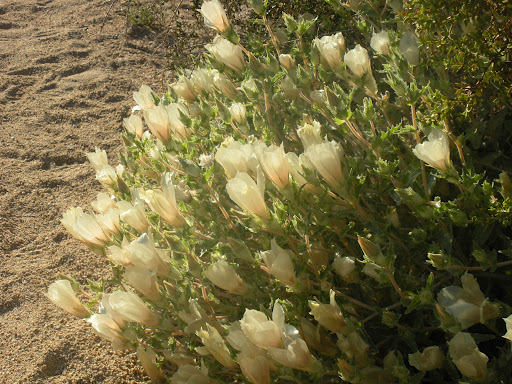
A desert Southwest saying is that “water is worth killing for.” Just off the I-10 in Palm Springs green golf courses drip damp with irrigation and green lawns are rimmed with bush after bush of perfect roses, while safely out of sight to the south the Colorado delta turns to mud and fishermen caught out by low tide crawl-swim on their bellies through a half mile of muck to reach the shore.

We come to the high desert to hear the echo of the ancient earth, to feel the heat beneath the April sun, and to witness the renewal that distains our hand.

Link to Desert Flower Photo Pics

Desert Lights

In the hills
of Joshua Tree,
A rough trail
among the rocks and creosote
yields a black stink beetle

digging through the armor
of the hardened ground,
baking in mid April,

while beneath relentless sun
the blooms of flowers
shine like supernova.


Art From Found Objects

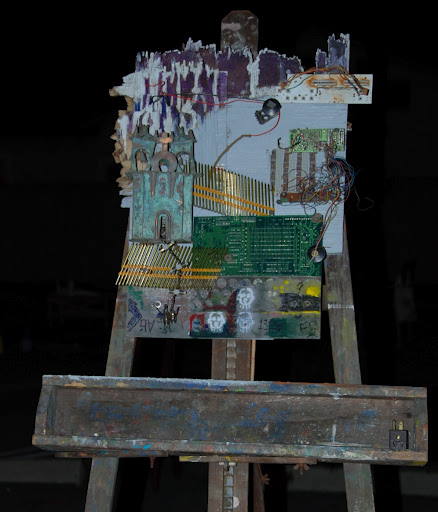
Many thanks to Downey resident Roy Shabla, who curated a show called “Contraptions: electrified, mechanized, digitized, funk-junk art show.” The show featured assembled whimsical gadgets, “useless” machines and art constructed from the discarded objects of our materialistic world. As you can see from the photos, the show took place in the evening, in the parking lots at Number 34 on Florence Avenue. Thanks Ronnie, the proprietor at Number 34!

An Art-Making Machine

(My apologies: I don’t remember the name of the artist)
For a brief introduction to the found objects art form, here is a link to the works of Ruben Acosta. His three- dimensional painting-like constructions displayed on easels at the Contraptions show inspired my poem “Art From Found Objects”

 A Piece by Ruben Acosta

Finally, here is a link to the world of Roy Shabla.
———————————————————————————————–
Art From Found Objects
on an easel
in a parking lot

scenes from life

are pieced together

layer upon layer
bits of paper and plaster
some wire and some paste

some color from an old paint can
a diagonal swath of gauzy mesh
family    friends    and kindred folks
tangled up with mending tape
to form a map of the wandering path
and the years I stumbled through

my vision is my vision
but found pieces that I pick
and those that somehow
come to me and stick
are green if they are green
no matter that my vision
calls for blue

and then my canvas too
reveals itself
as fragments held with glue
that gradually dissolve
to shed foundation pieces
a brother here
a city there
until the air flows
gently through

scraps of colored paper
and fellow wandering souls
swirl in the dusty wind
some come to rest
against the back
to find some daubs
of still-wet paste
that bond the paper
to the place
and form perhaps
the image of a face

the sun slants
through the parking lot
and lights the easel
part by part
the rhythm
and the shadows
spring alive
to become art

Copyright © 2012 Francis Kearns

Three A.M, Orono Calling


Three A.M, Orono Calling


For a week the Native American names that surrounded my youth have been following me everywhere.

 Penobscot

Kathadin

Millinockit

And last night in a dream I thought of Orono, Maine, the town where I lived from my kindergarden years until the 5th grade.

Three A.M, Orono Calling


Something wakes me at 3 AM in this Los Angeles suburb, but what I hear is the long ago tin clatter of a rusty alarm clock in a musty tent in a backyard in Orono, Maine.

Orono in the fifties was a sleepy town in the center of Maine, on the banks of the Penobscot River. In the winters the days were short and cold and the snow piled high, but summer days were long, and moisture and fog from the river turned everything green. Spreading trees shaded sidewalks and back yards, and grass grew so lush that children spent an entire week barefoot, only putting on shoes for Sunday service.

I was eight years old that summer, and my brother John was six. We roamed the town unsupervised, walking up to the center of town, exploring the fields that sloped down toward the river, or hanging out at various friends’ houses.

There were two forces that anchored the children’s’ universe in Orono. The first was the River. A large Northeastern river, the Penobscot was wide, grey and deep. It flowed quickly through Orono, and its banks were steep and slick with mud. Parents warned their children of the dire consequences that would befall them if for some reason they got near those banks. We heard tales of drowning, and, perhaps worse, tales of the punishment that would befall us if we even got close. For the most part we gave the banks of the Penobscot River a wide birth.

The other force was the railroad. The Bangor and Aroostook was a small railroad, now long gone, whose reason for existence was to haul the potato crop out of the farmland of Northern Maine down to the coast. Unlike the river, we were on close terms with the railroad. A single rusty engine pulling a few dozen cars would shake us children to our bones as it came right through town, down a little gully with grassy slopes, then across Pine street, our main route to school. The railroad crossing was marked by a faded white wooden “X” with “RR Xing” painted in peeling black paint. It was up to every driver approaching and every kid walking along the track to look for the train and listen for the slow blasts of the whistle.

After Pine Street, the train headed toward the river, where it crossed on a railroad bridge. This bridge loomed large in children’s mythic lore. It was long, spindly, and had a narrow wood planked walkway alongside the track all the way across the bridge. There was no fence or gate to keep anyone from walking out on that walkway. If you got caught out there on that long bridge when the thundering engine headed across, followed by clacking cars and grinding steel wheels – we were sure that no child could survive. One teenage boy who was said to have deliberately stood out there when a long freight came through was viewed by all of us as a living legend.

So we young children were intimately familiar with these lumbering freight trains of red white and blue box cars filled with potatoes and flat cars stacked with logs from the Northern forest. We would put pennies and nails on the track, sit up on the bank as the freight trains past, and gleefully run down to survey these results after the train had gone. This all seems dangerous, but it was hard to be surprised by these trains. You could almost feel the rails come alive when the train was a ways away. They were slow moving and noisy, the whistle was loud, and so none of us ever worried too much about playing and walking on the track.

But these were freight trains. We never saw a passenger train. There were rumors that one came through in the dead of night, and it was so fast and quiet that if you were on the track when it came through it would run you over before you even knew it was there. Our Dad was always willing to entertain our quest for information, so without seeming too interested we asked him about passenger trains on our tracks. A few days later he told us that the only passenger train that ran through Orono Maine came through town at 3 A.M. Well! Now this sounded like adventure!

My brother and I had for several weeks that summer been sleeping out in the back yard in a musty World War Two surplus pup tent. We found an old wind up alarm clock in a closet, snuck it out to the tent, and set it for two forty five. We woke up the next day as the sun peeked into the tent. The rickety old clock was still ticking, but some how or other we hadn’t set it right. So that day we conducted a number of tests, figured we had it, and set it again when we went to bed.

The alarm clock jangled in the dead of night. We fumbled around to quiet it for fear that someone would hear. Our eyes were sticky from sleep, but we pulled on our baseball caps and headed up Pine Street barefoot in the dark. Somehow it didn’t seem as dark as we had imagined it would be. We were exposed, and imagined the eyes of every neighbor and parent watching through black windows as we heading up toward town. But no one appeared, nothing moved. We reached the grassy bank overlooking the track, sat down in the grass and waited.

First we heard the faint click and sigh of the rails. We looked off toward the North, and sure enough we could see the headlight searching across the fields and down the track. Then the light flashed along our bank, and the train was here! At the head was the smooth bluff nose of an F3 locomotive, travelling fast and grinding its wheels as it raced around the curve toward Pine Street.

Nothing terrible happened to us. The wind pulled our hair and pajamas as the engine flew by. We grabbed glimpses of people asleep in their chairs through the windows of the smooth sliver cars. And then it was by us, the rounded tail of the last car swaying slightly and the red tail light growing fainter in the distance across the bridge, drawing our eyes with it down the far off track. We sat for a while after the rails grew quiet. We got up slowly and stepped off the bank onto Pine Street. Turning toward home, we could feel the pull. It lingered in the air, drawing us South down the track, toward places that we couldn’t name, away from Pine Street, and Orono Maine.

Copyright © 2011 Francis Kearns


The Seven A.M. Bus

The 111 bus runs from the Los Angeles Airport transportation center East along Florence Avenue . Crossing the 110 Freeway, it slices through some of the toughest neighborhoods of South L.A. Continuing East, it passes through the densely populated Latin American working class neighborhoods of Huntington Park, Bell and Bell Gardens before coming to a somewhat upscale section of Downey, where lush lawns and palm trees surround large newly constructed houses.

The Seven A.M. Bus

you’re in front of me
at the stop light
orange aluminum
dull windows
your high rubber tires
roll along through the morning damp
on your swaying journey
along Florence venue

roll your black tires
pump your pistons
sweep up the women
from the morning dark
they hold your cold seat rail
and stare out the window
drop them off
on the wide streets
of green lawns and palm trees

they wakened their daughters and sons
in the apartments of Huntington Park
and the little Bell Gardens houses
and packed a sandwich and piece of fruit
for their husbands

come back for them tonight
they look down the road
past the lines of cars
and strain to see you in the dark

roll your tires
spew your smoke
work your swaying orange magic
change them back
to laugh freely
tuck their children into bed
and hold their husbands’ hands
set them free tonight
these women
of the seven A.M. bus

Frank Kearns
February 12, 2012

So Cal Yankee Feedback

Dear Readers,

Thank you all for the kind comments that I have received. It is appreciated and encouraging!

Several friends have indicated that it was difficult to leave comments on the blog. By default Google required a  reader to register on one of the Google platforms in order to leave a comment. I have changed this setting. Now when asked to CHOOSE AN IDENTITY you can select NAME/URL and entering your name, or more simply select ANONYMOUS.

You still have to “prove you are not a robot” by re-typing the twisted distorted words that are displayed. I don’t know what to do about that yet …

So feel free to leave all the comments you want, in any form that works for you, including here on the blog.

Thanks,
Frank

Three A.M, Orono Calling


For a week the Native American names that surrounded my youth have been following me everywhere.

Penobscot

Kathadin

Millinockit

And last night in a dream I thought of Orono, Maine, the town where I lived from my kindergarden years until the 5th grade.

Three A.M, Orono Calling


Something wakes me at 3 AM in this Los Angeles suburb, but what I hear is the long ago tin clatter of a rusty alarm clock in a musty tent in a backyard in Orono, Maine.

Orono in the fifties was a sleepy town in the center of Maine, on the banks of the Penobscot River. In the winters the days were short and cold and the snow piled high, but summer days were long, and moisture and fog from the river turned everything green. Spreading trees shaded sidewalks and back yards, and grass grew so lush that children spent an entire week barefoot, only putting on shoes for Sunday service.

I was eight years old that summer, and my brother John was six. We roamed the town unsupervised, walking up to the center of town, exploring the fields that sloped down toward the river, or hanging out at various friends’ houses.

There were two forces that anchored the children’s’ universe in Orono. The first was the River. A large Northeastern river, the Penobscot was wide, grey and deep. It flowed quickly through Orono, and its banks were steep and slick with mud. Parents warned their children of the dire consequences that would befall them if for some reason they got near those banks. We heard tales of drowning, and, perhaps worse, tales of the punishment that would befall us if we even got close. For the most part we gave the banks of the Penobscot River a wide birth.

The other force was the railroad. The Bangor and Aroostook was a small railroad, now long gone, whose reason for existence was to haul the potato crop out of the farmland of Northern Maine down to the coast. Unlike the river, we were on close terms with the railroad. A single rusty engine pulling a few dozen cars would shake us children to our bones as it came right through town, down a little gully with grassy slopes, then across Pine street, our main route to school. The railroad crossing was marked by a faded white wooden “X” with “RR Xing” painted in peeling black paint. It was up to every driver approaching and every kid walking along the track to look for the train and listen for the slow blasts of the whistle.

After Pine Street, the train headed toward the river, where it crossed on a railroad bridge. This bridge loomed large in children’s mythic lore. It was long, spindly, and had a narrow wood planked walkway alongside the track all the way across the bridge. There was no fence or gate to keep anyone from walking out on that walkway. If you got caught out there on that long bridge when the thundering engine headed across, followed by clacking cars and grinding steel wheels – we were sure that no child could survive. One teenage boy who was said to have deliberately stood out there when a long freight came through was viewed by all of us as a living legend.

So we young children were intimately familiar with these lumbering freight trains of red white and blue box cars filled with potatoes and flat cars stacked with logs from the Northern forest. We would put pennies and nails on the track, sit up on the bank as the freight trains past, and gleefully run down to survey these results after the train had gone. This all seems dangerous, but it was hard to be surprised by these trains. You could almost feel the rails come alive when the train was a ways away. They were slow moving and noisy, the whistle was loud, and so none of us ever worried too much about playing and walking on the track.

But these were freight trains. We never saw a passenger train. There were rumors that one came through in the dead of night, and it was so fast and quiet that if you were on the track when it came through it would run you over before you even knew it was there. Our Dad was always willing to entertain our quest for information, so without seeming too interested we asked him about passenger trains on our tracks. A few days later he told us that the only passenger train that ran through Orono Maine came through town at 3 A.M. Well! Now this sounded like adventure!

My brother and I had for several weeks that summer been sleeping out in the back yard in a musty World War Two surplus pup tent. We found an old wind up alarm clock in a closet, snuck it out to the tent, and set it for two forty five. We woke up the next day as the sun peeked into the tent. The rickety old clock was still ticking, but some how or other we hadn’t set it right. So that day we conducted a number of tests, figured we had it, and set it again when we went to bed.

The alarm clock jangled in the dead of night. We fumbled around to quiet it for fear that someone would hear. Our eyes were sticky from sleep, but we pulled on our baseball caps and headed up Pine Street barefoot in the dark. Somehow it didn’t seem as dark as we had imagined it would be. We were exposed, and imagined the eyes of every neighbor and parent watching through black windows as we heading up toward town. But no one appeared, nothing moved. We reached the grassy bank overlooking the track, sat down in the grass and waited.

First we heard the faint click and sigh of the rails. We looked off toward the North, and sure enough we could see the headlight searching across the fields and down the track. Then the light flashed along our bank, and the train was here! At the head was the smooth bluff nose of an F3 locomotive, travelling fast and grinding its wheels as it raced around the curve toward Pine Street.

Nothing terrible happened to us. The wind pulled our hair and pajamas as the engine flew by. We grabbed glimpses of people asleep in their chairs through the windows of the smooth sliver cars. And then it was by us, the rounded tail of the last car swaying slightly and the red tail light growing fainter in the distance across the bridge, drawing our eyes with it down the far off track. We sat for a while after the rails grew quiet. We got up slowly and stepped off the bank onto Pine Street. Turning toward home, we could feel the pull. It lingered in the air, drawing us South down the track, toward places that we couldn’t name, away from Pine Street, and Orono Maine.

Copyright © 2011 Francis Kearns

Painting Lascaux

Last summer Carol and I visited the Dordone Valley in Southwestern France, where there are numerous caves with prehistoric paintings from over 20,000 years ago. The most famous of these is Lascaux, with its spectacular “Hall of Bulls”. These caves represent an amazing record of prehistoric man.

Earlier we had visited the Picasso Museum in Barcelona, Spain. There we saw how Picasso deconstructed and rebuilt the images he saw around him into a fresh vision of the world. His paintings are the work of a genius painter and a transcendental seer. The painters of the caves of Southern France reveal the same genius in both painting and insight into the world around them.

Here is a link to the Lascaux cave:
http://www.lascaux.culture.fr/index.php?fichier=00.xml

Painting Lascaux

Returning from the hunt with the men
the boy idly traces
the back of a horse
on the muddy river bank
when something in the line
the trueness of the image
pleases him

he draws line after line
image after image
and some take on
a life of their own
so that adults walking by say
ah that’s nice

and when he closes his eyes and sees
a horse tumbling through space
or a cow jumping high in the air
hind legs tucked up in delight
he paints     and others feel
the tingle of mystery

the elders
watch all this and nod
and one day
take him by the hand
come they say
it’s time for you
to paint the cave

Copyright © 2011 Francis Kearns

Fresh Snow

December brings thoughts of snow, even here in Southern California. My bedroom at my parent’s house was on the second floor, and a flood lamp hung in the eaves just above the window. On a winter night I would fall asleep watching the snow shoot out of the dark into the glare of the light.

Fresh Snow

last night
an endless veil of snow
streamed past my window

today each boot step
marks my path
into the woods

the old signs are gone
the snow erases
the tangled browns and greens

of pine needles and saplings
blended earth colors of
chipmunk and quail

now new traces
one by one
my trail

and a single set
of rabbit tracks
etched across the glade

Copyright © 2011 Francis Kearns